In the news
ProImmune Collaboration
ProImmune collaborates with The University of Texas Medical Branch to advance infectious disease research
ProImmune, Ltd., a global leader in immunological reagents and services, today announced a collaboration with The University of Texas Medical Branch (UTMB) Galveston National Laboratory (GNL), a high-containment, infectious disease research facility, to develop innovative tools for studying high-consequence emerging and endemic infectious diseases. Under the agreement, ProImmune's Ankyrons will be evaluated as molecular tools to enable precise detection, localization, and functional interrogation of viral proteins across complex experimental systems compatible with high-containment research.
The collaboration combines ProImmune's Ankyron® target binding reagent technology with the GNL's expertise in the immunopathology of emerging viruses. Studies will be carried out in the laboratory of Dr. Courtney Woolsey which specializes in the study of emerging and endemic viral pathogens under maximum-containment conditions (BSL-4) to investigate viral protein function, immune dysregulation, and tissue-specific responses that inform the next-generation of vaccines and therapeutics. The teams will initially focus on validating Ankyrons specific for viral proteins from pathogens of major global health concern, including Bundibugyo virus, Zaire ebolavirus, Sudan ebolavirus, Reston ebolavirus, Human Enterovirus 71, and Mpox virus.
Ankyrons are a novel class of small (∼15 kDa), single-domain binding reagents based on an engineered ankyrin-repeat scaffold that enables high affinity and specificity for diverse protein targets. Generated through a fully in vitro, high-throughput selection process, Ankyrons can be rapidly identified, optimized, and produced without the need for animal immunization, making them well suited for time-sensitive infectious disease research. Ankyrons are already available for 60 pathogens and disease vectors and can be rapidly developed for new and emerging disease targets.

UNVEIL
UPDATE 2-Health experts meet in search of Ebola Bundibugyo vaccine options
Apanel of experts led by the World Health Organization meets on Tuesday to discuss whether there are any vaccine options to help tackle an Ebola outbreak in eastern Democratic Republic of Congo. The virtual meeting follows more than 130 suspected deaths and 500 cases linked to the outbreak of the Bundibugyo strain of Ebola, according to the WHO, which, along with the Africa Centers for Disease Control and Prevention, has declared it a public health emergency.
There are no approved vaccines or treatments for the Bundibugyo strain of Ebola, which has a fatality rate of up to 40%. VACCINE OPTIONS
However, there is a vaccine named Ervebo, manufactured by Merck, that is used for the Ebola Zaire strain but has shown evidence of providing some protection against Bundibugyo in animal studies. The potential for testing this and other options will be on the agenda of the meeting of the WHO Technical Advisory Group, the WHO and other scientists said. But the final decision will lie with the governments of Congo and neighbouring Uganda, where two confirmed cases have also been found. Potential treatments will also be discussed.
"When you have an outbreak with a strain that does not have countermeasures, we are going to advise on the best approach to take," said Dr Mosoka Fallah, acting director of the science department at Africa CDC. "We will look at what evidence we have and make a decision." The vaccine group Gavi holds a stockpile of Ebola vaccines. Its chief executive, Sania Nishtar, said 2,000 doses were already in Congo, if the experts decided it should be used in a trial there.
Some experts said the outbreak could still be difficult to control. "Our concern about this outbreak is pretty high," said Richard Hatchett, head of the Coalition for Epidemic Preparedness Innovations, which funds the development of new vaccines and is looking at potential candidates.
He said a 2018-19 outbreak in the same region of Congo, caused by Ebola Zaire, took two years to control because of the security situation there, even with a vaccine that was already approved and available for use. "The security situation is very serious, and so testing things in clinical trials will be challenging, but will be necessary as well," he said.
There are "substantial" barriers to moving a Bundibugyo-specific vaccine toward emergency or clinical use, said Courtney Woolsey, assistant professor at the University of Texas Medical Branch. "From a regulatory standpoint, Bundibugyo outbreaks are rare and unpredictable, which makes traditional efficacy trials difficult," Woolsey said.
Health experts meet in search of Ebola Bundibugyo vaccine options.
There are no approved vaccines or treatments for the Bundibugyo strain of Ebola, which has a fatality rate of up to 40%.
However, there is a vaccine named Ervebo, manufactured by Merck (MRK.N), opens new tab, that is used for the Ebola Zaire strain but has shown evidence of providing some protection against Bundibugyo in animal studies.
The potential for testing this and other options will be on the agenda of the meeting of the WHO Technical Advisory Group, the WHO and other scientists said. But the final decision will lie with the governments of Congo and neighbouring Uganda, where two confirmed cases have also been found. Potential treatments will also be discussed.
"When you have an outbreak with a strain that does not have countermeasures, we are going to advise on the best approach to take," said Dr Mosoka Fallah, acting director of the science department at Africa CDC. "We will look at what evidence we have and make a decision."
The vaccine group Gavi holds a stockpile of Ebola vaccines. Its chief executive, Sania Nishtar, said 2,000 doses were already in Congo, if the experts decided it should be used in a trial there.
Some experts said the outbreak could still be difficult to control.
"Our concern about this outbreak is pretty high," said Richard Hatchett, head of the Coalition for Epidemic Preparedness Innovations, which funds the development of new vaccines and is looking at potential candidates.
He said a 2018-19 outbreak in the same region of Congo, caused by Ebola Zaire, took two years to control because of the security situation there, even with a vaccine that was already approved and available for use.
That's according to the Director-General of the Africa Centers for Disease Control and Prevention, Dr Jean Kaseya.
"The security situation is very serious, and so testing things in clinical trials will be challenging, but will be necessary as well," he said.
There are "substantial" barriers to moving a Bundibugyo-specific vaccine toward emergency or clinical use, said Courtney Woolsey, assistant professor at the University of Texas Medical Branch.
"From a regulatory standpoint, Bundibugyo outbreaks are rare and unpredictable, which makes traditional efficacy trials difficult," Woolsey said.
INVADE
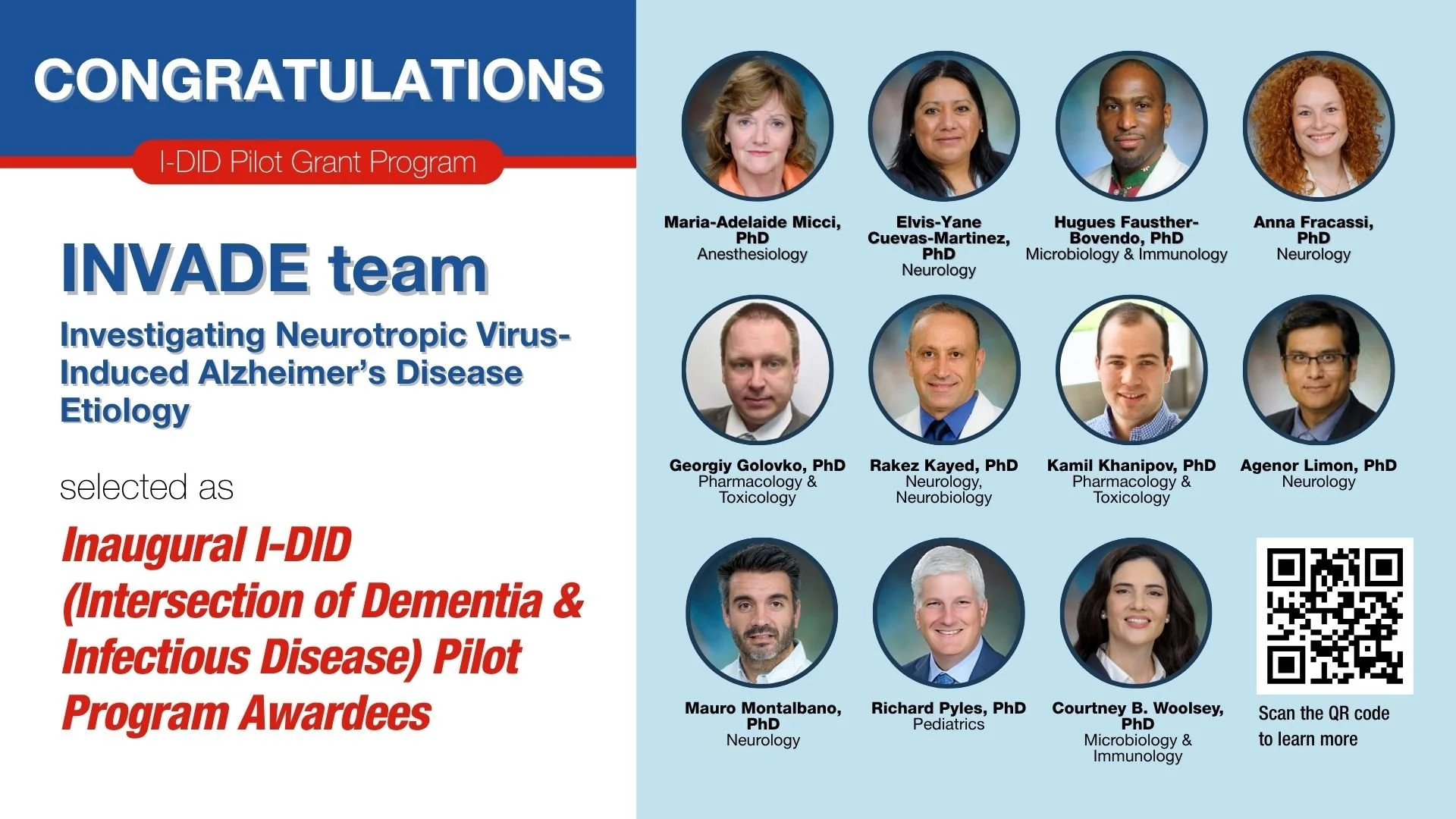
INVADE Team Selected as Inaugural I-DID Pilot Program Awardee
INVADE (Investigating Neurotropic Virus-Induced Alzheimer’s Disease Etiology) is a collaborative effort focused on how neurotropic viral infections may contribute to Alzheimer’s disease and related dementias. We use acute and persistent viral infection models to ask when, where, and how viruses tip neural circuits and glial networks toward chronic injury and degeneration. By connecting virology, brain immunology, and neurodegeneration, INVADE aims to identify mechanisms by which infections accelerate or unmask Alzheimer-like pathology and to uncover targets for prevention and intervention in vulnerable populations.
UNVEIL
Global UNVEIL Initiative Launches to Fast Track Lassa fever Vaccine Development.
UNVEIL (Unraveling Natural- and Vaccine-Elicited Immunity against Lassa Virus) is a multi-site effort to better understand how the immune system responds to Lassa virus infection and vaccination in humans and relevant animal models. The goal is to identify practical immune readouts that can guide Lassa vaccine development and evaluation.
Working with partners in West Africa and international collaborators, the project brings together:
Clinical cohorts in endemic regions to characterize immune responses after natural infection and vaccination
Nonhuman primate and small animal models to define correlates of protection under controlled conditions
Integrated immune profiling – including antibody function, T-cell responses, and systems-level analyses – to link immune patterns with clinical outcomes
By comparing immunity induced by natural infection and by candidate vaccines, UNVEIL aims to define measurable markers of protection that can support future Lassa vaccine trials and help prioritize the most promising candidates.
TEAM SCIENCE
Nigeria Joins $6.4m Global Lassa Fever Vaccine Research.
Nigeria has joined a new $6.4 million international research consortium aimed at accelerating the development of a vaccine against Lassa fever.
This was made known in a statement made available to the News Agency of Nigeria (NAN) by the Coalition for Epidemic Preparedness Innovations (CEPI) on Sunday in Abuja.
The initiative, tagged Unravelling Natural and Vaccine-Elicited Immunity to Lassa fever (UNVEIL), is led by the University of Texas Medical Branch (UTMB), with funding support from CEPI.
NAN reports that three Nigerian institutions, Jos University Teaching Hospital, Irrua Specialist Teaching Hospital, and Abubakar Tafawa Balewa Teaching Hospital, Bauchi, will serve as frontline clinical sites under the project.
They will work alongside the Kenema Government Hospital in Sierra Leone.
The research will focus on identifying immune markers or correlates of protection, biological signatures in blood or cells that indicate immunity to Lassa fever.